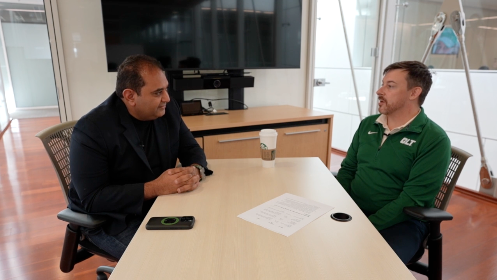
For this episode, I visited the PORTAL building at UNC Charlotte to sit down with Dr. Mohamed Shehab—a professor whose mobile development course keeps showing up in conversations with students as one of the most impactful experiences of their degree.
I’ve heard it repeatedly from students I’ve hired: “Dr. Shehab’s course changed how I think about building software.” When you hear that kind of feedback consistently, you have to ask what he’s doing differently.
Why students remember this course
I originally connected with Dr. Shehab after noticing the pattern. Current students, recent grads, people years into their careers—they all talked about his mobile dev class the way you talk about a course that actually stuck.
The answer is pretty straightforward: it’s hands-on, industry-aligned, and constantly evolving.
Dr. Shehab started teaching mobile development in 2008, right when the iPhone App Store launched. He got lucky with timing, but what kept the course relevant was the approach: flip the lecture material to video, use class time for hands-on work, teach students to ship working apps—not just pass exams.
The tech changes constantly. Updates every few months. So the course has to change with it. Students learn how to build, deploy, and debug real applications. They encounter the same decision-making tradeoffs developers face in production.
That’s the alignment. Students walk out with job-ready experience, not just academic knowledge.
Embracing AI (and changing how you evaluate)
We spent a lot of time talking about AI in the classroom. Dr. Shehab’s take is pragmatic: the technology is here, students are using it, developers are using it—you have to adapt.
But it creates real challenges for educators. How do you evaluate student understanding when they can generate code with a chatbot?
Dr. Shehab’s approach: change how you evaluate. Don’t just check if the app runs—have students demo it and explain how it works. Ask questions. Make them walk through their code. If they used GPT to build it but can understand and articulate the solution, that’s acceptable. If they can’t explain it, they get half credit.
He’s also experimenting with GitHub Copilot in the development environment—teaching students to use AI as an assistive tool, not a replacement for understanding.
The goal isn’t to block AI. It’s to teach students how to use it effectively while still building foundational skills.
Build, build, build
I asked what advice he gives students trying to break into the job market—especially when entry-level roles feel harder to land and AI is changing expectations.
His answer was clear: build things.
Don’t just do assignments. Build real projects. Put them on GitHub. Deploy them. Show your work.
The biggest challenge right now is for early talent. If you’re graduating and want to stand out, you need a strong portfolio. You need to show up to employers with something you’ve built—not expecting them to hold your hand and train you from scratch.
Communication matters too. AI can do a lot of things, but it can’t be you. Being a good collaborator, explaining things clearly, presenting confidently—those skills still matter.
And get involved outside the classroom. Go to meetups. Join student orgs. Use the maker spaces. Network. Ask questions at recruiting events—even if you think the question is stupid. Have presence.
Dr. Shehab’s motto: build, build, build. No hand-waving. Features built = points. No features = no points.
The maker space movement
One of the more interesting parts of our conversation was the emphasis on maker spaces. UNC Charlotte has invested heavily—3D printers, CNC machines, fabrication labs. Students can access them for free.
Dr. Shehab’s point: the university isn’t going to teach you everything in the classroom. A lot of learning happens outside—in maker spaces, student orgs, side projects. Open yourself to other experiences. Print something. Build something. See what’s possible.
When companies interview students and see that breadth of experience—someone who’s not just focused on one narrow skill but has built, experimented, and solved real problems—that opens doors.
Building stronger industry partnerships
We also talked about what industry can do to be better partners with academia.
More collaboration. More joint projects. More events on campus exposing students to the ecosystem. More feedback to faculty on what skills actually matter in the market.
Dr. Shehab mentioned that UNC Charlotte is exploring focused talent pipelines—where companies have input on curriculum and certificate programs. Containerization certificates. Visualization certificates. AI certificates. Programs designed not just for traditional students but for employees or potential employees.
The challenge is cultural. A lot of academics are traditional: teach a class, do research, go home. But exposing faculty to industry—and integrating those relationships—can boost relevance for everyone.
Why I wanted him on the show
I’m incredibly grateful to Dr. Shehab for making time to be part of The Data Pour. Seeing the level of impact he’s had on students is what motivated me to get more involved at UNC Charlotte—to help create stronger pathways between academia and industry.
I’m excited to continue working together in the future.
Watch the episode
If you want the full conversation—including the parts on the PORTAL incubator, startup culture, and what Dr. Shehab sees as the future of CS education—watch the YouTube episode here: