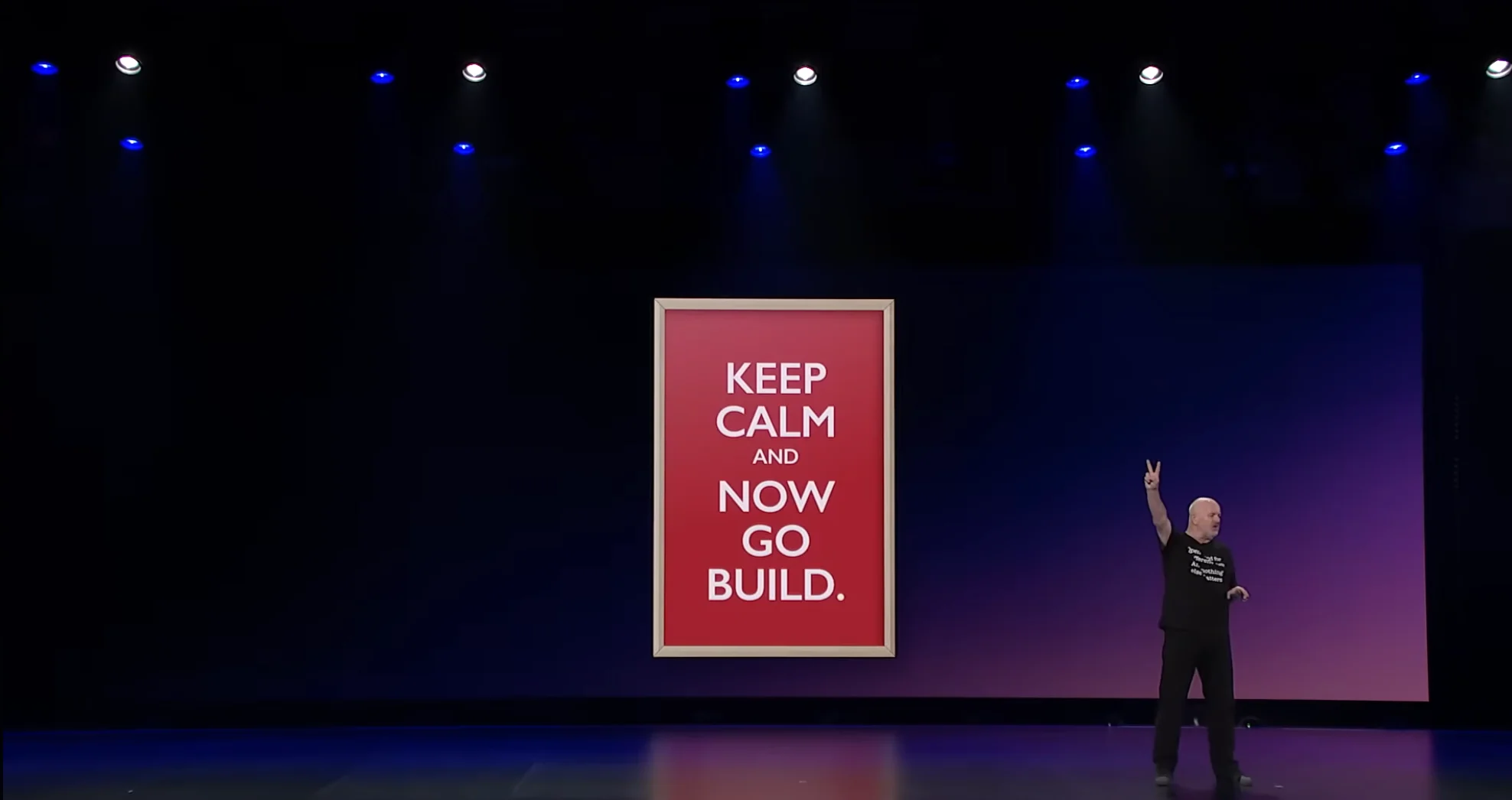
When I talk to students — especially STEM students — one question keeps coming up: “Is AI going to take my job?” They ask it jokingly, but you can tell they’re serious. What they want is assurance. They want to know there’s a light at the end of the tunnel. That the late nights, the debt, the effort, and the hope they’ve poured into their degree will amount to something real.
And I rarely give a quick answer, because the truth is uncomfortable: maybe. It’s not the certainty anyone wants, but it’s honest.
For a long time, I danced around that answer. I hedged. I emphasized the optimistic parts, hoping they would land softer. But last week, during his final re:Invent keynote, Werner Vogels showed us how to talk about this moment with clarity instead of avoidance.
He walked the audience through the history of software development — from punch cards and COBOL to structured programming, object orientation, distributed systems, the cloud, and now agentic AI. In every era, developers were convinced the sky was falling. And in some ways, it was. Punch-card clerks disappeared. Mainframe operators disappeared. Entire roles vanished because something faster, cheaper, and more scalable came along.
But one role never disappeared: the builder — the person who understands systems, solves real-world problems, thinks in abstractions, and brings ideas to life.
That’s the part people forget. Technology doesn’t just destroy. Technology democratizes. It opens doors. And it does so in waves.
Every wave has displaced someone. Every wave has taken something away. But every wave has also created something bigger for the people willing to evolve. Builders adapted. They reskilled. They moved up the stack. They went from pushing paper to writing code, from writing code to designing systems. The pattern is always the same: a wave arrives, jobs shift, and the builders who lean in rise with it.
I’ve lived through enough of these waves to see the pattern clearly.
The first wave I experienced was the World Wide Web. Before the web, we logged into CompuServe, posted on message boards, browsed clunky online catalogs. And then came the browser — Netscape, Mosaic, whatever arrived on your screen first. Suddenly anyone with a little HTML could put a page online for the entire world to see. The web was so small in those days that there were literal lists of websites. That’s how new it was.
And that was the first time technology felt like something you could create with, not just consume. The web democratized publishing and expression. It changed how we interacted with the world — Amazon instead of bookstores, eBay instead of classifieds — and it changed what it meant to be a builder. You didn’t need a printing press or a distribution network. You needed curiosity and a willingness to learn a markup language.
Then came the cloud. Suddenly anyone with a credit card and a vision could become a global service provider. You didn’t need a server room. You didn’t need procurement approvals. You didn’t need capital. The cloud collapsed the distance between idea and impact. Entire companies were born in dorm rooms because the playing field had leveled.
And now we’re in the third wave: agentic AI. Tools that can generate code, test it, reason about it, orchestrate systems, and solve problems alongside you — without you manually writing every line. You don’t need specialized hardware or a custom model. You can build on top of general-purpose models, wrap your logic behind a Model Context Protocol, and stand up entire services in hours. Once again, the gap between imagination and execution has narrowed.
This is what Vogels calls the Renaissance Developer — someone who cultivates depth and breadth. Someone who goes deep enough to solve hard problems but understands enough of adjacent systems to see the whole picture. Someone who stays curious, thinks in systems, communicates clearly, takes ownership, and adapts when the next wave comes.
Because there will always be a next wave.
So when students ask whether AI will take their job, I finally know how to answer. The question is slightly off. The better question is: What can I build with AI?
If you define yourself by a tool — a language, a framework, a stack — then yes, you’re in trouble. Tools come and go. They always have. The developers who clung to punch cards got left behind. The ones who refused to learn the web got left behind. The ones who ignored the cloud got left behind. And the ones who dismiss AI will get left behind too.
But if you define yourself by what you create — if you define yourself as a builder — then AI isn’t a threat. AI is another wave of democratization. AI is a force multiplier. AI is the next thing that expands what’s possible for people willing to evolve.
The path forward isn’t about predicting the next dominant framework or clinging to one narrow specialty. The path forward is about building. That’s the one thing AI cannot replace: the human who knows what should exist and has the drive to bring it to life.
So will AI take your job? Maybe. Probably, if the job is defined purely by a tool.
But will AI take away your ability to create, adapt, imagine, build? No. It won’t. It can’t.
If you lean into what it means to be a Renaissance Developer, then AI doesn’t close the door on your future. AI blows it wide open.