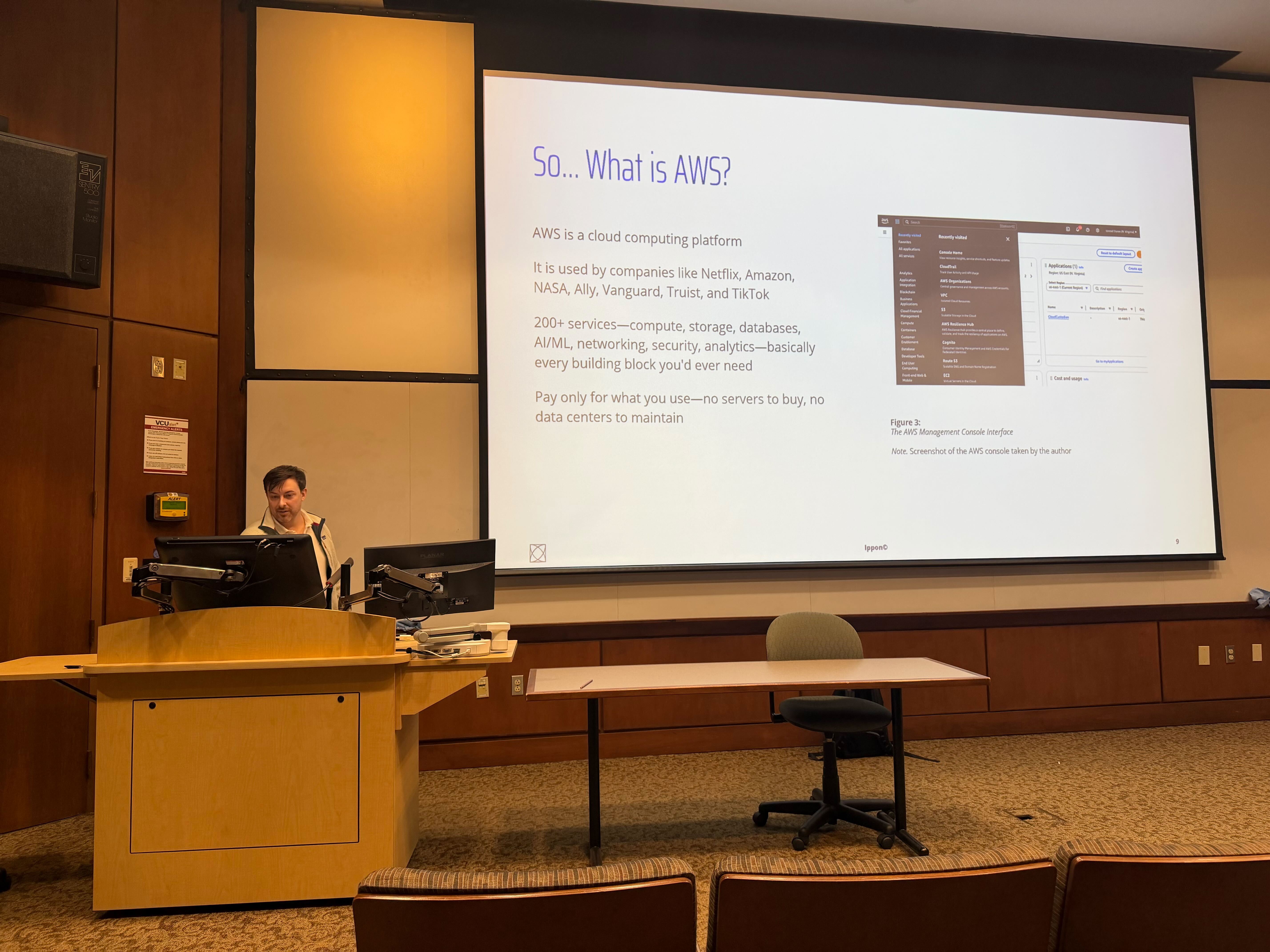
I had the privilege of speaking at the Department of Computer Science at Virginia Commonwealth University’s College of Engineering on March 3rd, presenting “Cracking the Cloud: How AWS Certifications Can Launch Your Career” to a group of engaged Computer Science seniors.
The Presentation
My talk focused on how early-career technologists can differentiate themselves in an increasingly competitive field. Three themes anchored the session: strategic certifications — particularly AWS certifications as a way to validate cloud skills before you have the job title to back them up — self-directed projects that demonstrate practical problem-solving, and building genuine relationships in the industry. That last one always gets a laugh because I tell students it sometimes means getting away from the keyboard entirely and, as I like to say, “doing a little grass touching.”
I shared my own path — leveraging AWS certifications early to get into high-visibility projects as industries were actively migrating to cloud. While I had to update a few dates from previous versions of the deck, the core message has only gotten more urgent.
AWS: The Connective Tissue of AI and Data
One thread I came back to throughout the talk is that there has never been a better time to learn AWS than right now. AI and data technologies are advancing at a pace that makes prior tech cycles look like dress rehearsals. AWS isn’t just infrastructure anymore — it’s the connective tissue that binds these technologies together and makes them deployable at enterprise scale.
From Amazon Bedrock for foundation model integration to SageMaker for MLOps, AWS is where the theoretical promise of AI meets production reality. For students entering the workforce today, cloud architecture fluency is no longer a specialty — it’s table stakes. The engineers who understand how to wire these services together, govern them properly, and make them perform under real-world constraints are the ones who will lead.
VCU’s CS Program: Engineering Discipline Meets Modern Stack
What made this talk particularly meaningful was the audience. VCU’s BS in Computer Science, housed within the College of Engineering, puts a serious emphasis on applied problem-solving. By the time students reach their senior year, they’re deep into a two-semester capstone sequence — Senior Design Studio I and II — where they spend six dedicated lab hours per week building real, sponsored projects. These aren’t toy applications. Students are working with faculty advisors and external partners, going through the same design-implement-test-validate loop you’d find in a professional engineering org.
The program also offers concentrations in areas like cybersecurity, software engineering, and AI, and has interdisciplinary ties to VCU’s biomedical engineering and health informatics programs. That breadth creates students who think across problem domains rather than staying narrowly within their lane — which matters enormously when you’re trying to architect cloud solutions for a complex enterprise.
It doesn’t hurt that VCU is a genuinely charming place to spend four years. The Monroe Park campus sits inside the Fan District — an 85-block Victorian neighborhood that claims the largest concentration of intact late-19th-century row houses in the country. Walk a few blocks in any direction and you’re into independent coffee shops, tree-lined streets, and houses that have been standing since before anyone knew what a computer was. It’s the kind of environment that makes you want to linger after a talk, and we did.
Students also benefit from Richmond’s growing tech ecosystem. The city is no longer just a financial services hub; it’s attracting a broader range of companies looking for engineering talent, and VCU’s career services and engineering partnerships reflect that.
VCU vs. UNC Charlotte: Format Shapes the Room
Comparing this presentation to my previous talks at UNC Charlotte’s College of Computing and Informatics was instructive — not because one program is better than the other, but because the format difference fundamentally changes who’s in the room and why.
At VCU, I spoke to roughly 150 students — the entire senior cohort. Everyone was at the same inflection point in their academic journey, which created a particular kind of focused energy. There was no self-selection happening; this was a scheduled session for the class, which means the full range of interests and backgrounds was represented.
My sessions at UNC Charlotte were structured differently. Those presentations were voluntary — students who wanted to learn more about cloud careers showed up because they specifically sought it out. Around 50 students attended, and as you’d expect from a self-selected group, the baseline curiosity about cloud was higher walking in the door. UNC Charlotte’s CCI is a large program in its own right — close to forty full-time faculty and over 450 graduate students — with concentrations spanning AI/Robotics/Gaming, Data Science, and Cybersecurity. Charlotte’s position as a major fintech hub also shapes how those students think about technology; there’s an implicit finance-and-data lens that I don’t have to establish from scratch, which helps when you’re talking about cloud architecture in financial services.
Both groups were genuinely engaged. The difference was in the questions. The UNC Charlotte sessions had a sharper cloud-specific focus from the start — which makes sense given who opted in. At VCU, the questions were broader, and about a fifth of them centered on mainframes. I was impressed by the VCU students trying to mentally map architectures to problems.
The Recruiter’s Perspective
I was fortunate to have Lindsey Rodriguez join us remotely to share the view from the hiring side. Lindsey’s perspective grounded the session in a way that purely technical talks can miss. Certifications matter in initial résumé screens — they signal intentionality and give a recruiter something concrete to anchor on when differentiating candidates with similar academic backgrounds. But what matters downstream is demonstrating practical problem-solving and the ability to translate technical complexity for non-technical stakeholders. That combination — technical credibility plus communication — is what gets early-career engineers into high-visibility roles quickly.
Acknowledgments
None of this would have happened without Khawlah Harahsheh, Laura Lemza, and Rebecca Kurihine, whose organization and hospitality made the day run smoothly. Thanks also to Devin Veasna for capturing photos of the session.
I’ve already connected with several students from the day and I’m looking forward to watching them build things. There’s a particular kind of energy in a room full of people who are technically sharp and genuinely curious about the industry they’re about to enter. Sessions like this remind me why community engagement matters beyond the metrics — it’s an investment in people who are going to be shaping the stack for the next twenty years.