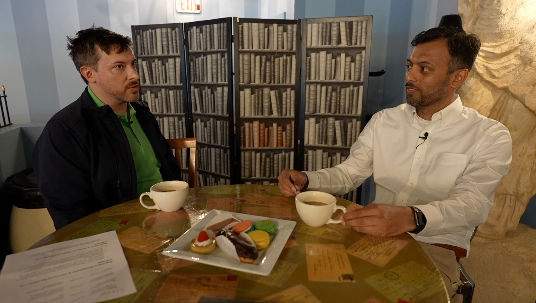
For this episode of Data Pour, I sat down with Nimish Donde—Head of Cloud Platform and Security Engineering at Truist—at Amélie’s French bakery in Charlotte. It’s a place that’s been part of the city’s fabric since 2008, growing from a single 24-hour location in NoDa (that I used to frequent during college) to four locations across Charlotte.
Like this bakery, Charlotte’s tech scene has grown and evolved—and Nimish has been part of that transformation for the past 16 years.
Why Nimish
Nimish is one of my closest friends and mentors. We both worked on Ally’s cloud transformation together—15 years for him at Ally, where he helped navigate a massive financial institution through one of the most significant technology shifts in banking.
Now he’s at Truist, a much larger bank, tackling similar challenges but at an even greater scale. And what I’ve always valued about Nimish is his ability to cut through the noise. He doesn’t chase technology trends—he focuses on what actually delivers value to customers, builds trust with people, and creates platforms that work.
This conversation was long overdue. We grabbed French press coffee (the kind you order at Amélie’s in those big presses), settled in, and talked about everything from resiliency and chaos engineering to Charlotte’s evolution as a fintech hub.
Charlotte: the second-largest financial hub in America
One of the threads we explored early was Charlotte itself. It’s the second-largest financial hub in the United States—home to Bank of America, Wells Fargo, Truist, Ally, and a growing number of financial enterprises setting up operations.
Over the past two decades, Nimish has watched the city transform from just a banking hub into a tech-financial hub—the birthplace of fintechs, a magnet for cloud talent, and a city where people now want to move for their careers, not just pass through on their way to New York or Silicon Valley.
Charlotte showed grit after the 2008 financial crisis. The city came back stronger, the tech scene expanded, and the talent pipeline from local universities (UNC Charlotte, Wake Forest, UNC, USC) started feeding directly into these financial institutions.
Even Amélie’s mirrors that resilience. This location shut down during the pandemic but came back in 2023—booming again, just like the city itself.
Cloud platforms as products, not projects
Nimish’s role at Truist breaks down into three core tenets:
- Developer experience and enablement — Lower the barrier to entry so more teams can build on the platform
- Resiliency and reliability — Ensure customers (internal developers) get maximum value
- AI and data gravity — Enable the platform to accelerate AI journeys
The key insight here: cloud platforms are products, not operational systems.
Too many organizations treat cloud as infrastructure to manage. Nimish treats it as a product with customers—and those customers are the developers building applications that serve end users. Everything flows from that mindset.
Resiliency is a mindset, not a metric
We spent a significant chunk of the conversation on resiliency—something both of us are obsessed with.
Nimish’s definition: resiliency is a mindset, not a destination.
Gone are the days when you measured platform quality by uptime percentages. Resiliency today is about the experiences you build for customers. It’s about how you respond under stress. It’s about building systems that anticipate failure, learn from it, and continuously improve.
He referenced the SRE evolution—Beno Ventures’ famous line: “Hope is not a strategy.” That philosophy shaped how Nimish approaches resiliency today.
Chaos engineering as a first-class citizen
One of the most interesting parts of our discussion was around chaos engineering.
Regulators—especially in Europe with legislation like DORA—are no longer accepting tabletop exercises as proof of resiliency. They want evidence. They want to see that under stress, your systems still deliver value.
Chaos engineering isn’t just a nice-to-have anymore. It’s becoming a compliance requirement. It’s how you prove resiliency in production. And for banks, that shift is profound.
Nimish believes chaos engineering will become a first-class citizen in the audit process—just like security compliance scores today. You’ll need to validate your platforms’ resilience continuously, not just once a year.
The 80/20 rule: technology is the easy 20%
A theme that came up repeatedly: technology is the easy part.
Whether it’s on-prem systems or cloud platforms, the binary is only 20% of the challenge. The other 80%? People.
Bringing people along on transformation. Building influence. Convincing risk partners, internal audit, regulators, and developers that this is the right model. Creating feedback loops. Enabling self-service while embedding guardrails.
Nimish has mastered that 80%. And he’s clear about it: if you can’t influence people, your platform will fail—even if the technology is perfect.
Data gravity and AI: you can’t skip the foundation
We talked extensively about data gravity—the idea that data needs a central home, properly cataloged and governed, before AI can deliver real value.
Nimish’s take: garbage in, garbage out.
You can’t unlock AI value if your data is in disparate locations, inconsistent, or inaccessible. Executive sponsorship is critical. You need investment in data warehousing, enrichment, cataloging, and lineage before you start training large language models.
His advice for enterprises: eat your own dog food.
If you’re the cloud platform team, build your own data warehouse. Use the platform you’re providing to developers. Give them transparency into their usage. Lower the barrier to entry by shining a light on dark spaces where people wouldn’t normally pay attention.
That transparency accelerates the entire organization’s AI journey.
Guardrails as code: the tiered cake model
Nimish shared his tiered cake model for building secure, compliant platforms—an analogy that resonated deeply (especially sitting in a French bakery):
- Base layer: Landing zones with preventative and detective controls (policies, SCPs, IAM boundaries)
- Second layer: Data visibility—a warehouse that tells the story of what’s happening on your platform
- Third layer: Proactive controls—CI/CD, Infrastructure as Code, reusable templates, inner source
- Cherry on top: Human interaction—communities of practice, office hours, self-service tools
Each layer has guardrails baked in. And when packaged together, you can hand the whole thing to auditors and regulators with full transparency on ingredients, processes, and governance.
The result? Developers move fast. Compliance is embedded. And the enterprise is protected.
Advice for young engineers: be resilient, adaptable, and comfortable with ambiguity
I asked Nimish what he’d tell a young engineer aspiring to leadership.
His answer: three things matter most:
- Resilience — Bounce back. Learn from failure. Keep going.
- Adaptability — The tech changes constantly. Your ability to evolve matters more than what you know today.
- Comfort with ambiguity — Leadership isn’t clean. You won’t always have the answer. Learn to navigate uncertainty.
And most importantly: have empathy. Understand people. Use that as an accelerator.
Technology skills get you in the door. Soft skills keep you there.
Why this conversation mattered
Nimish and I have known each other for years, but this was the first time we sat down and recorded a full conversation about the work we’ve been doing. It felt less like an interview and more like two friends catching up—talking through transformation, resiliency, Charlotte’s evolution, and where the industry is heading.
I’m grateful he made time to do this. If you work in cloud, fintech, or platform engineering—or if you’re just curious about what it takes to build systems that scale in highly regulated environments—this episode is worth your time.
Watch the full episode
This blog is just the teaser. If you want the full story—including our takes on agentic AI, the growth of Charlotte’s microbrewery scene (which somehow correlates with the tech scene), and Nimish’s upcoming hike to Machu Picchu—watch the episode.
And if you’re ever in Charlotte, grab a salted caramel brownie at Amélie’s. Nimish has been a fan for 15 years. I’m partial to the pistachio macaron.
Watch the full Data Pour episode here:
https://youtu.be/3xuco4R8EHE?si=QF5JkEeSglcnfG0n