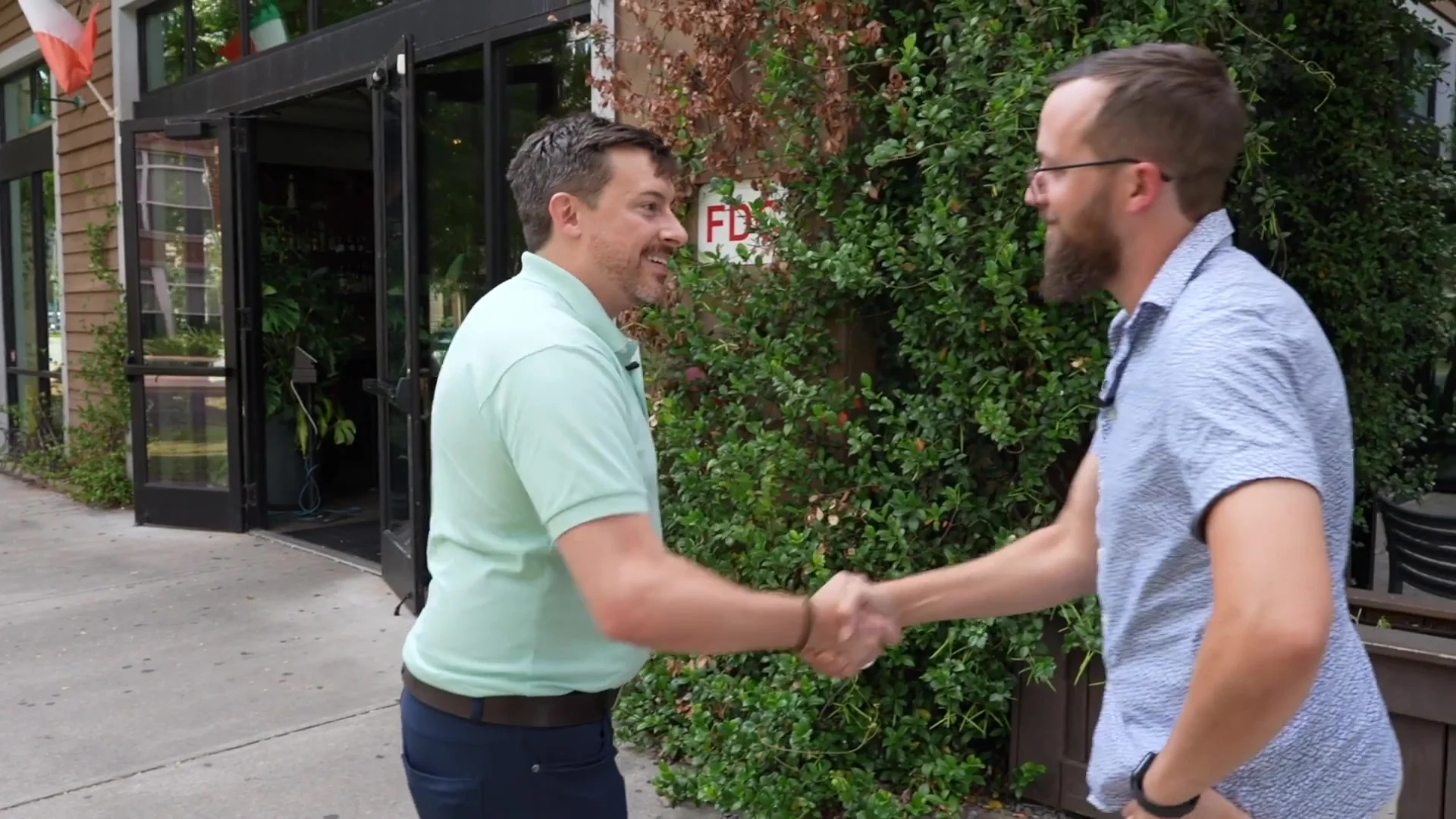
For this episode of Data Pour, I sat down with Lucas Ward—one of my SWE managers and a senior technical manager at Ippon—to talk about what it actually looks like to lead people in a consulting practice while the industry is shifting under our feet.
We filmed at the Charlotte Beer Garden, which feels like the most Charlotte setting possible: more taps than you can count, plus the steady soundtrack of loud cars and motorcycles rolling by. We both went with an OMB beer (Mecktoberfest) because… you kind of have to.
If you want the full conversation, watch the YouTube episode—this post is the background and the highlights.
Why I wanted Lucas on the show
Lucas isn’t just a strong engineer—he’s the kind of leader who can translate. In consulting, that’s the job: you’re constantly moving between client expectations, delivery realities, and the growth of the people on your team.
And Lucas has lived both sides.
He broke into tech the hard way—after years in restaurants—then got his start at a small Charlotte business where he had to wear every hat imaginable: shipping code, running systems in production, taking late-night calls when something broke, and learning by doing because there wasn’t anyone else to do it.
That “wear every hat” foundation shows up in how he leads today.
People leadership in consulting is a different sport
One of the most real parts of our conversation was the dynamic of managing people when you aren’t sitting next to them every day.
In a traditional org, you see the work constantly. In consulting, your direct report might be on another client, another team, another tech lead. Sometimes you’re getting signal through check-ins and feedback loops rather than direct observation—which makes coaching and performance conversations trickier (and honestly, more important to handle thoughtfully).
Lucas talked about what it means to guide technical folks who are laser-focused on hard skills—while also helping them build the soft skills that determine whether they actually grow: communication, delivery, stakeholder management, and the ability to explain why the work matters.
Technical skills get you a seat at the table. The rest is what keeps you there.
“Consultant” = solve the problem and explain the value
Lucas gave a definition I loved:
A consultant is someone who can make the square peg fit in the round hole—and then explain how they did it to the people who care about the peg fitting.
That’s the work. Not just building. Translating. Connecting technical decisions to business outcomes. Helping stakeholders understand what’s happening and why it matters.
Enterprise vs midsize: don’t write off the “breadth” engineers
We also dug into how midsize clients operate differently than large enterprises—and what each can learn from the other.
Enterprises have specialization and depth. Midsize companies often have engineers with ridiculous breadth because they’ve had to take products through the entire lifecycle—build, deploy, operate, support.
Lucas’s advice to enterprise hiring managers was simple: don’t dismiss candidates from smaller companies. They may not have the same “one deep slice” experience, but they often bring systems thinking and end-to-end ownership that’s hard to teach.
AI readiness: everybody wants AI, but not everyone is ready
This came up a lot:
Large enterprises are thinking about data strategy, fine-tuning, governance, and ROI.
Midsize companies often want AI, but their data is siloed, inconsistent, and not operationally prepared for “real” AI use cases.
And Lucas made a key point: AI readiness is incremental—and most of what you do to become “AI ready” is just good engineering anyway. Clean data, lineage, security controls, sustainable platforms, well-architected foundations. AI just forces the conversation.
Also: not every problem is an LLM problem. Traditional ML is having a comeback for a reason—it’s often cheaper, easier to operationalize, and more effective for specific tasks.
Career advice Lucas would give (and what he’d tell you)
Lucas’s advice for people trying to break into tech right now:
Stick to it.
Don’t let the AI noise psych you out. There are plenty of companies nowhere near “AI-first” that still need great engineers. Take the shot, even if it’s not the shiny job. Keep side projects going. Show your work. Stay learning. Don’t give up.
And the advice he’d give himself 10 years ago was even better:
If you’re stuck, challenge your assumptions. Step back. Look elsewhere. There are more solutions than you think—most people just burn time spinning in one lane.
Watch the episode
This one is for anyone navigating leadership, consulting, or just trying to stay sane while AI changes the shape of the industry.
Watch the full Data Pour episode with Lucas Ward here: https://www.youtube.com/watch?v=732vznyGndQ&t=1011s